
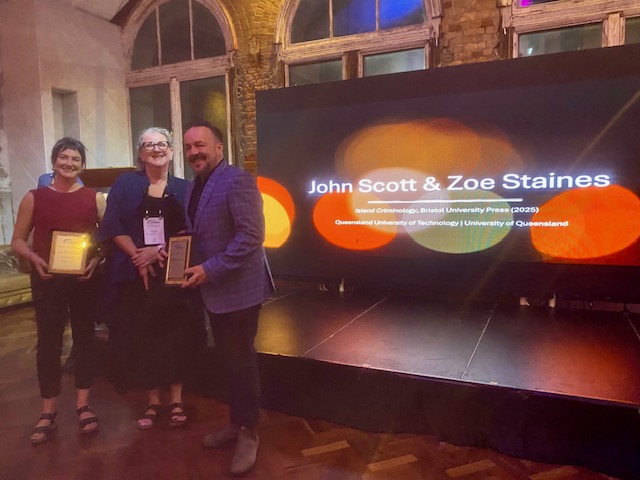
QUT Centre for Justice member Professor John Scott and co-author Dr Zoe Staines were recognised with the Australasian criminology’s top book award in December, for their work Island Criminology (Bristol University Press, 2024).
The Christine M. Alder Book Award is designated biannually by the peak regional professional body for justice research, the Australian and New Zealand Society of Criminology. It awarded for an outstanding book which, in the opinion of the selection panel, has made a valuable and outstanding contribution to criminology.
The panel provided the following feedback:
This theoretically sophisticated work provides important insights about islands from a criminological perspective, making a significant intellectual contribution by centring regional and remote perspectives often overlooked in mainstream criminological discourse. The emphasis on First Nations expertise and experiences of place is particularly valuable. By exploring characteristics such as isolation and insularity, and considering the meaning of ‘islandness’ and island tropes as both ‘idylls and horrors’, this beautifully written exploration establishes historical and theoretical foundations for new research areas. The book highlights the importance of space and place in island research, providing rich historical and contemporary examples that invite further investigation.
Scott said of the award:
‘As we state in the book, islands are often at the periphery of peripheries and have been mostly invisible to criminologists, despite housing ten percent of the world’s population. When islands show up in criminology it is pretty much through a western or northern gaze, with most studies being about tourists and crime and Caribbean, where North Americans take their holidays. So, charting a place for islands in criminology is important, not only because islands are unique environments, but because they connect us to contemporary criminological debates, including those associated with decolonisation and green criminology. There is also a network of island scholars who are highly active in the South Pacific and are producing new ideas and concepts that are fundamental to a global and democratised criminological landscape.’


Comments are closed.